
Trees
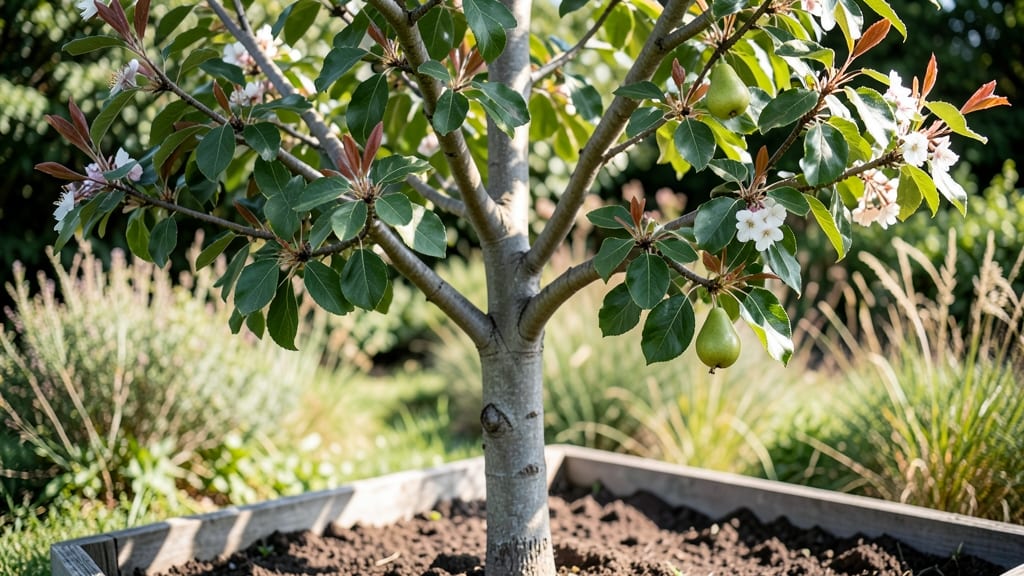
Pear tree leaves look like elongated ovals with smooth, glossy surfaces and finely serrated edges that taper to a sharp point. They grow alternately along branches, typically spanning 2 to 4 inches with visible parallel veins and a slightly waxy feel.
These distinctive leaves help identify pear trees even from a distance. 🌿 The deep green color and smooth texture set them apart from similar fruit trees like apples, whose leaves often have more pronounced serrations or rougher edges.
I've noticed that young leaves start lighter in color and develop their characteristic glossiness as they mature, which can be a helpful clue when distinguishing between species in an orchard.
One key trick I use is comparing leaf arrangement—pear tree leaves grow alternately along the branch, unlike some other fruit trees where they might appear more clustered.
The parallel veins also create a subtle ribbed pattern that's unique to pears, making them easier to spot even when the tree isn't in bloom.
💡 In This Article
- Identifying Pear Tree Leaves: Key Botanical Features
- How to Differentiate Young vs Mature Pear Tree Leaves
Identifying pear tree leaves: key botanical features
The shape of pear tree leaves is what first catches your eye when you're scanning an orchard or garden. These leaves are oval to elliptical, meaning they're wider in the middle and gradually narrow toward both ends, though the tip is noticeably more pointed than the base.
Think of it like an elongated egg—smooth and symmetrical, with the pointed tip often angled slightly downward. This shape helps distinguish them from apple tree leaves, which tend to be more rounded at the base and less uniformly tapered.
What makes pear leaves truly stand out is their glossy, deep green surface that almost shimmers in sunlight. This isn't just a pretty detail—it's a survival adaptation.
The waxy coating on the leaves reduces water loss through evaporation, which is crucial for trees growing in temperate climates where moisture can be seasonal. 🌿 Under magnification, you'd see tiny microscopic hairs along the veins that contribute to this waxy feel.
The edges are what botanists call "serrated," but they're finely toothed rather than the jagged saw-like edges you'd find on cherry tree leaves.
The vein structure is another key identifier. Pear tree leaves feature parallel secondary veins that run from the central midrib toward the edges, creating a subtle ribbed pattern. These veins aren't as prominent as in maple leaves but are more visible than in apple leaves.
The central vein is particularly sturdy, providing structural support to the leaf's elongated shape. When you run your fingers along the underside, you'll notice these veins create a network that's more orderly than the random branching you'd find in many other fruit trees.
Size matters too—pear leaves typically measure between 2 to 4 inches long and about 1.5 to 2.5 inches wide, though this can vary slightly depending on the specific pear variety.
For comparison, apple tree leaves are often slightly larger (up to 5 inches) and have more pronounced serrations that look like tiny teeth under close inspection.
The arrangement is equally telling: pear leaves grow alternately along the branch, meaning each leaf emerges from a different point on the stem rather than clustering in pairs or groups.
Texture plays a surprising role in identification. While most people focus on appearance, the slightly waxy feel of pear leaves is distinctive when touched. This isn't the rough texture of cherry leaves or the velvety softness of some plum varieties.
The waxiness comes from a layer called the cuticle that helps protect against pests and disease. In dry conditions, this wax can become more pronounced, making the leaves feel almost slightly slippery between your fingers.
Here's a quick comparison to help you spot the differences in the field:
- Shape: Pear (oval-elliptical) vs Apple (more rounded base) vs Cherry (more lance-shaped)
- Edge: Pear (fine serrations) vs Apple (coarser teeth) vs Cherry (almost smooth with tiny points)
- Vein Pattern: Pear (parallel secondary veins) vs Apple (more branched network)
- Surface: Pear (glossy/waxy) vs Apple (matt to slightly rough) vs Cherry (duller)
When you're trying to identify a tree in person, start by looking at these four features together—the shape, edge type, vein pattern, and surface texture.
Most fruit trees have at least one feature that doesn't match these characteristics, making pear trees relatively easy to spot once you know what to look for. 🌱