
Pruning
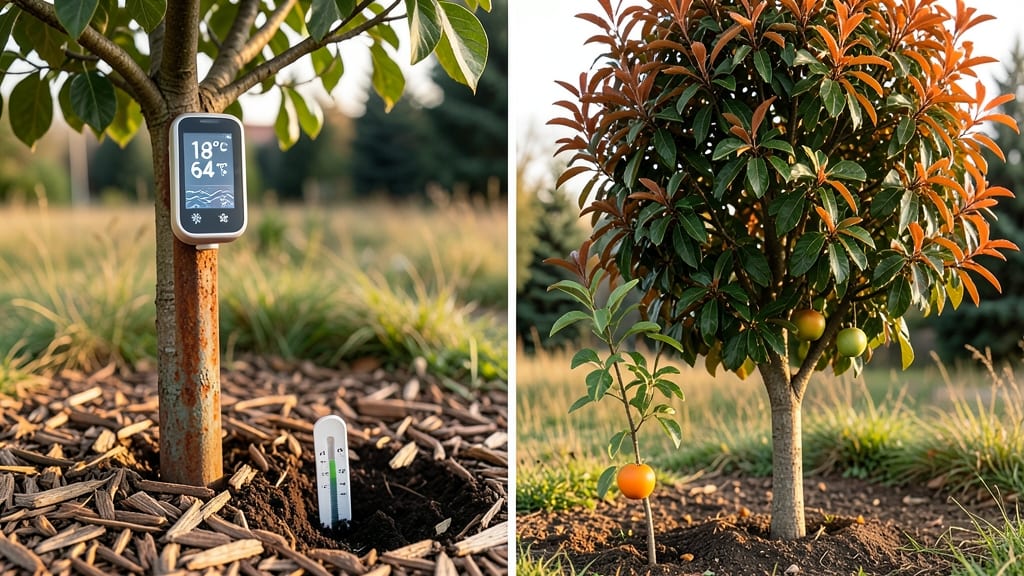
Persimmon trees tolerate cold temperatures best in hardiness zones 5 through 9, surviving down to -15°F (-26°C) once fully mature, while young trees require protection against anything below 0°F (-18°C).
Understanding a persimmon tree's cold tolerance helps you plan for winter survival. 🌳 Mature trees develop thicker bark and deeper root systems that act as natural insulation, while younger trees lack these protective features.
The key difference between Asian and American varieties lies in their native climates—American persimmons evolved in colder zones and generally handle frost better than their Asian counterparts. Proper winter preparation, like mulching and wrapping, can push even zone 4 trees to survive temperatures they'd normally struggle with.
For gardeners in colder regions, the first step is choosing the right variety. American persimmons like 'Meader' or 'Hachiya' often outperform Asian types in zone 5, while Asian persimmons such as 'Fuyu' may need winter protection in zone 6.
The critical factor is consistent soil moisture before winter—dry soil makes trees more vulnerable to cold damage. I've found that adding 4-6 inches of organic mulch around the base creates a protective barrier that maintains root temperature stability, even when air temperatures drop.
💡 In This Article
- Understanding Persimmon Tree Cold Hardiness by Variety
- Winterizing Persimmon Trees for Extreme Cold
Understanding persimmon tree cold hardiness by variety
The cold tolerance of persimmon trees varies dramatically between Asian and American varieties due to their evolutionary origins. American persimmons, native to the southeastern U.S., evolved in climates with hard freezes, allowing them to develop natural adaptations like thicker bark and deeper root systems that insulate against cold.
These varieties can handle temperatures down to -20°F (-29°C) once mature, though young trees need protection below 10°F (-12°C). Their native resilience makes them better suited for zones 4-5 with proper care.
Asian persimmons, on the other hand, originated in warmer climates of East Asia and generally struggle below 15°F (-9°C) without protection. Varieties like 'Fuyu' and 'Hachiya' have thinner bark and less cold-hardy root structures, making them more vulnerable to winter damage.
The key difference lies in their cellular structure—American persimmons produce higher concentrations of antifreeze proteins in their sap during winter, preventing ice crystal formation in their vascular system. This biological adaptation allows them to maintain water transport even in sub-zero conditions.
Age plays a critical role in temperature tolerance. Young persimmon trees (3 years old) lack the protective bark thickness of mature trees and are more susceptible to cold damage. Their root systems are shallow, making them vulnerable to soil temperature fluctuations.
In contrast, established trees develop a 1-inch-thick bark that acts as insulation, reducing heat loss by up to 30%. Proper winter care, like mulching and wrapping, can extend the cold tolerance of young trees by 5-10°F, helping them survive in zones where they'd normally perish.
Soil moisture levels before winter significantly impact cold hardiness. Persimmon trees store water in their roots and bark during fall, which helps them withstand freezing temperatures. Dry soil forces trees to deplete these reserves early, leaving them more vulnerable to winter damage.
I've observed that trees in well-drained but consistently moist soil can tolerate 5°F colder temperatures than those in dry or waterlogged conditions. This is why autumn irrigation is crucial—it ensures trees enter winter with full water reserves.
Another critical factor is the tree's exposure to wind. Persimmon trees in open, windy areas lose heat 30-50% faster than those sheltered by buildings or other vegetation. Wind chill can drop effective temperatures by 10-15°F, making trees appear more cold-hardy than they actually are.
Planting in sheltered microclimates or using windbreaks can improve survival rates in marginal zones. For example, a 'Meader' persimmon in zone 5 might survive -18°F (-28°C) with protection, while the same tree in an exposed location could suffer damage at -10°F (-23°C).
Finally, the role of sunlight exposure matters. Trees receiving full sun develop stronger bark and more robust root systems, improving their cold tolerance. In contrast, shade-grown persimmons have thinner bark and weaker structural support.
This is why gardeners in colder zones should prioritize planting locations with at least 6-8 hours of sunlight daily, even if it means sacrificing some winter protection. The increased photosynthesis during growing season directly translates to better winter resilience.