
Pruning
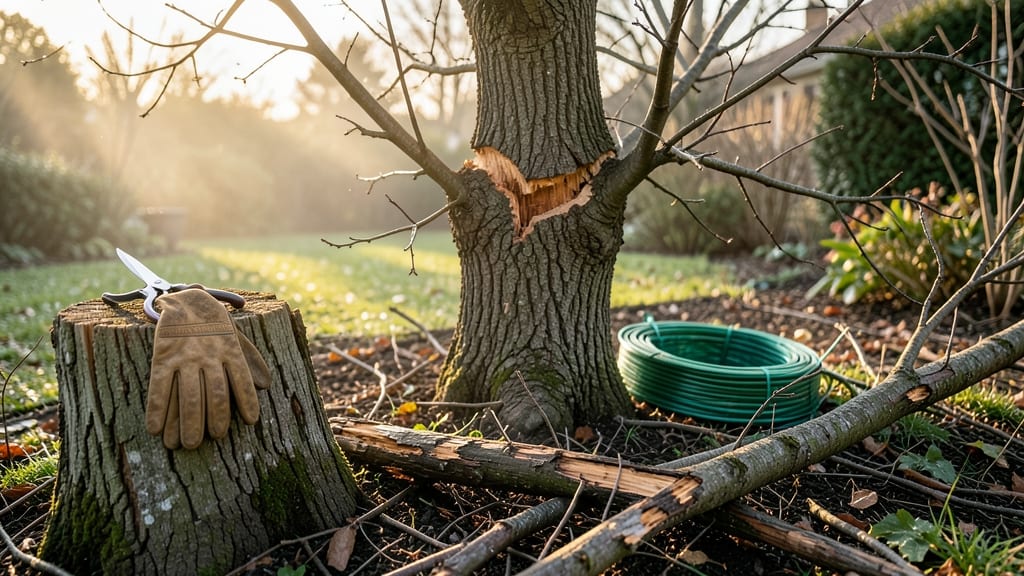
A tree broke in half in your yard—now what? 🌳 The first 24 hours determine whether your tree can be saved or needs removal.
I’ve stabilized snapped trees myself, and here’s exactly what to do next to assess damage, secure the trunk, and decide whether pruning or professional help is the right call.
Start by assessing the split: if the break is clean and the top still has leaves, there’s hope. But if the trunk is cracked or the top is dangling precariously, it’s time to call an arborist.
For now, remove any broken branches within 10 feet of structures or power lines—safely, with gloves and a pruning saw. Never climb or lean on a damaged tree.
If the tree is still standing, you can attempt stabilization with 3/4-inch cables and turnbuckles, following proper tension techniques. The goal is to keep the trunk upright while new growth fills the break. With proper care, some trees recover beautifully—others are better removed to prevent further damage.
After the emergency, focus on long-term health: check for disease, improve soil drainage, and prune strategically. If the tree is beyond saving, dispose of the wood responsibly—many communities offer free chipping services. Either way, this is your chance to turn a crisis into better tree care moving forward.
Hidden Weaknesses Exposed
When a tree suddenly snaps in half, it’s often the result of long-term stress or structural flaws that finally gave way. Understanding these underlying causes can help you prevent future damage and save other trees on your property. Here’s why it happens—and what you can do about it.
---
A tree’s strength relies on healthy, solid wood. Over time, decay, fungal infections, or insect damage can weaken its internal structure, making it far more susceptible to snapping under stress.
- Fungal Rot (🍄): Fungi like Armillaria or Ganoderma break down wood fibers, creating hollow pockets.
Even if the tree looks healthy on the outside, the inside may be swiss-cheese weak. - Bark Infections (🦟): Diseases like anthracnose or honey fungus weaken the bark and underlying tissues, reducing structural integrity. - Insect Infestations (🐜): Bark beetles, borers, and termites tunnel through wood, creating tunnels that weaken the tree’s core.
💡 Pro Tip: If a tree has mushrooms growing at its base or oozing sap, it’s a red flag for hidden rot. A certified arborist can use resistograph testing (a drill-based diagnostic tool) to check for internal decay before it becomes a safety hazard.
---
Storms, high winds, and heavy snow or ice loads can push a tree beyond its limits—but not all trees break the same way.
- Wind Throw (💨): A shallow root system (common in newly planted or fast-growing trees) can’t anchor the tree properly.
When winds exceed 30-40 mph, even healthy trees can uproot or snap mid-trunk. - Ice or Snow Accumulation (❄️): Heavy ice buildup acts like a dead weight, bending branches until they snap like a twig.
Evergreens are especially vulnerable because their foliage catches snow. - Lightning Strikes (⚡): A direct hit can vaporize moisture in the wood, causing internal cracks that weaken the tree over time.
⚠️ Warning Sign: If a tree has large, dead branches or a leaning trunk, it’s already at higher risk of failure in a storm. Prune strategically to reduce wind resistance.
---
Some trees are genetically predisposed to weak structure, while others develop problems due to improper pruning or crowding.
- Co-Dominant Stems (🌿): When two (or more) equal-sized leaders grow from the trunk, they compete for dominance, creating a V-shaped crotch that’s prone to splitting. - Included Bark (📏): If branches grow too closely together, the bark gets trapped between them, restricting nutrient flow and weakening the union point. - Over-Pruning or Topping (✂️): Removing too many branches at once forces the tree to grow weak, water-sprout limbs that snap easily in storms.
🔧 Fix It: If your tree has multiple leaders, an arborist can thin out the weakest to promote a single strong trunk. Never top a tree—it’s a surefire way to invite structural failure.
--- A tree’s roots are its foundation—if they’re struggling, the whole tree becomes unstable.
- Compacted or Poor Soil (🏗️): Clay-heavy or waterlogged soil restricts root growth, while compacted soil (from construction or foot traffic) prevents roots from spreading. - Root Girdling (🔗): Circular roots (from root-bound nursery trees) or soil settling can strangle the trunk, cutting off nutrients and weakening the wood. - Drought Stress (💧): Prolonged dry spells make wood brittle and prone to cracking.
Even after rain, the damage may already be done.
🌱 Solution: Mulch properly (2-4 inches deep, kept away from the trunk) and water deeply during droughts. If roots are girdling, root collar excavation may be needed.
--- Sometimes, a tree breaks due to direct human or animal interference.
- Vehicle or Equipment Impact (🚗🚜): A single hit can crack the trunk or sever major roots, leading to a slow decline—or a sudden snap. - Animal Damage (🐿️🐿️): Beavers, deer, or even squirrels can gnaw on bark or roots, weakening the tree over time. - Construction or Utility Work (🔧): Buried cables, trenches, or heavy machinery can sever roots, leaving the tree top-heavy and unstable.
🛡️ Prevention: Install tree guards in high-risk areas and avoid parking near mature trees. If construction is necessary, hire an arborist to protect the tree’s root zone.
--- Even the healthiest trees eventually reach the end of their lifespan. As they age:
- Wood Becomes Brittle (🧓): Lignin (the compound that gives wood strength) degrades over time, making older trees more prone to snapping. - Hollow Hearts (🪵): Some species (like oak, maple, and willow) naturally develop hollow centers as they age, reducing structural support. - Natural Decay (🍂): Heart rot (a common issue in older trees) can go unnoticed until a storm reveals the damage.
🌳 What to Do: If your tree is over 50 years old, have it inspected annually for signs of decay. Removal may be the safest option if it poses a risk.
--- Before a tree breaks, it often shows warning signs.
Watch for: ✅ Large, dead branches (especially if they’re hanging precariously) ✅ Deep cracks or splits in the trunk or major limbs ✅ Fungal growth at the base or on the trunk ✅ Leaning excessively (more than 15-20° from vertical) ✅ Peeling or sunken bark (a sign of poor circulation)
If you notice these, act fast—a professional assessment can prevent a catastrophic failure.
Fixing a Split Tree Safely
When a tree breaks in half, panic can set in—but quick, strategic action can save both the tree and your property. Below are practical, step-by-step solutions tailored to the most common causes of a snapped trunk or limb, along with prevention tips to keep your trees standing strong for years.
---
🔧 Emergency Stabilization (First 24–48 Hours) 1. Assess the Risk Immediately 🚨 - If the tree is leaning dangerously toward structures, power lines, or roads, do not attempt to move it yourself. Call a certified arborist or emergency tree service. - If the break is high up but stable, prioritize securing the area with caution tape or barriers to prevent accidents.
2. Temporarily Support the Tree (If Safe) 🛠️ - Use stakes and ropes (not wire—it can cut into the bark) to gently brace the broken sections.
Loop the rope around the trunk and stake, but never pull tight—this can cause further damage. - For large limbs, cable the break with a tree cabling kit (available at garden centers) to redistribute weight.
3. Remove Hazardous Debris 🪓 - Cut away sharp or jagged edges of the break with pruning shears or a handsaw (wear gloves and eye protection). - If the broken limb is too heavy to move alone, use a pruner’s saw to make clean cuts at the base of the limb to reduce weight.
💡 Pro Tip: If the tree is a valuable species (like an oak or maple), an arborist may attempt to save the crown by carefully splicing the break with tree repair epoxy—but this is rare and requires expert judgment.
---
🌱 Long-Term Salvage & Pruning 1. Determine if the Tree Can Be Saved 🌿 - If the break exposes rotted or hollow wood, the tree may not recover. In this case, partial removal (removing only the damaged section) might be the best option. - If the cambium layer (the green, living tissue under the bark) is intact, the tree might heal—though it’s unlikely to fully regrow.
2. Prune Aggressively to Reduce Stress ⚡ - Remove all dead, diseased, or weakly attached branches to lighten the load. - Thin the canopy (cut back to the outer third) to improve airflow and reduce wind resistance. - Never top the tree (cutting the main trunk flat)—this creates dangerous regrowth and weakens the structure further.
3. Monitor for Further Decay 🚨 - Check the break site monthly for mushroom growth, oozing sap, or cracking bark—signs of fungal infection. - If decay spreads, consult an arborist about selective pruning or removal.
✨ Prevention Tip: Regular structural pruning (every 3–5 years) removes weak branches before they become hazards. Focus on the "3-cut method" for large limbs to avoid tearing the bark.
---
🔄 Corrective Actions & Future Care 1. Fix Poor Pruning Cuts ✂️ - If the break was caused by over-pruning or improper cuts, the tree’s structure may already be compromised. - Do not prune further until an arborist evaluates the tree—removing too much at once can kill it.
2. Reinforce the Tree’s Stability 🏗️ - For young trees, use tree supports (like tree ties and stakes) to guide growth and prevent future splits. - For mature trees, cabling and bracing can help redistribute weight in high-risk areas (like where branches meet the trunk).
3. Adjust Watering & Soil Care 💧 - Overwatering or drought stress weakens wood.
Keep soil moist but not soggy, and mulch around the base (but not touching the trunk) to retain moisture. - If the tree is root-bound, aerate the soil or plant in a larger area to improve stability.
💡 Pro Tip: If the tree is a fruit or nut tree, avoid heavy fruit loads—thin out excess growth to prevent future splits.
---
Sometimes, saving the tree isn’t possible—and that’s okay. If: ✅ The trunk is more than 50% broken ✅ The tree is leaning at a 45°+ angle with no support ✅ The root system is severely damaged ✅ The tree is dead or diseased beyond repair
🔨 Safe Removal Steps: 1. Call a Professional 📞 – Never remove a large tree yourself. Arborists use rigging techniques, cranes, or sectioning to avoid damaging nearby trees or structures. 2. Check Local Regulations 📜 – Some areas require permits for tree removal, especially if the tree is protected. 3. Replace Thoughtfully 🌱 – If the tree was a shade provider or privacy screen, plant a new one in its place (choose a species with similar growth habits).
🌟 Prevention for the Future: - Plant the right tree in the right place (avoid fast-growing, weak-wooded species like willows near structures). - Inspect trees annually for cracks, mushrooms, or leaning—catch issues early! - Invest in a soil test—poor nutrition weakens wood over time.
--- Final Note: A broken tree is a wake-up call—whether you save it or remove it, proactive care ensures your next tree stays healthy and hazard-free. 🌳💪
Frequently asked questions
Can I save my tree if it's broken in half?
It depends on how clean the break is and whether the tree's inner tissue (cambium layer) is still intact. If the break is clean and the top section remains upright, there's a chance the tree can heal—especially if you stabilize it with 3/4-inch cables and prune damaged branches. However, if the trunk is cracked or rotted, removal may be safer. Always consult an arborist for valuable or large trees.
How do I know if my tree is beyond saving?
Watch for these red flags: hollow wood, mushrooms growing at the base, large cracks, or a trunk that's more than 50% broken. If the tree leans at a 45°+ angle or has severely damaged roots, it's likely too unstable to save. When in doubt, call a professional for an assessment.
What's the safest way to remove a broken tree myself?
Never attempt to remove a large tree alone—it's extremely dangerous. For small branches, use pruning shears and wear gloves and eye protection. If the tree is large, call an arborist who uses rigging techniques and proper equipment. Check local regulations first—some areas require permits for tree removal.
How can I prevent other trees from breaking in storms?
Start with proper pruning every 3-5 years to remove weak branches, and avoid topping trees. Mulch 2-4 inches deep (but not touching the trunk) to improve soil health, and water deeply during droughts. For high-risk trees, consider cabling and bracing to support weak branch unions.
Will my insurance cover tree damage from a storm?
It depends on your policy. Most homeowners' insurance covers sudden and accidental damage from storms, but there may be deductibles or exclusions for certain tree species or locations. Document the damage with photos and check your policy details before filing a claim. For large trees, you may need an arborist's report to support your claim.