
Size
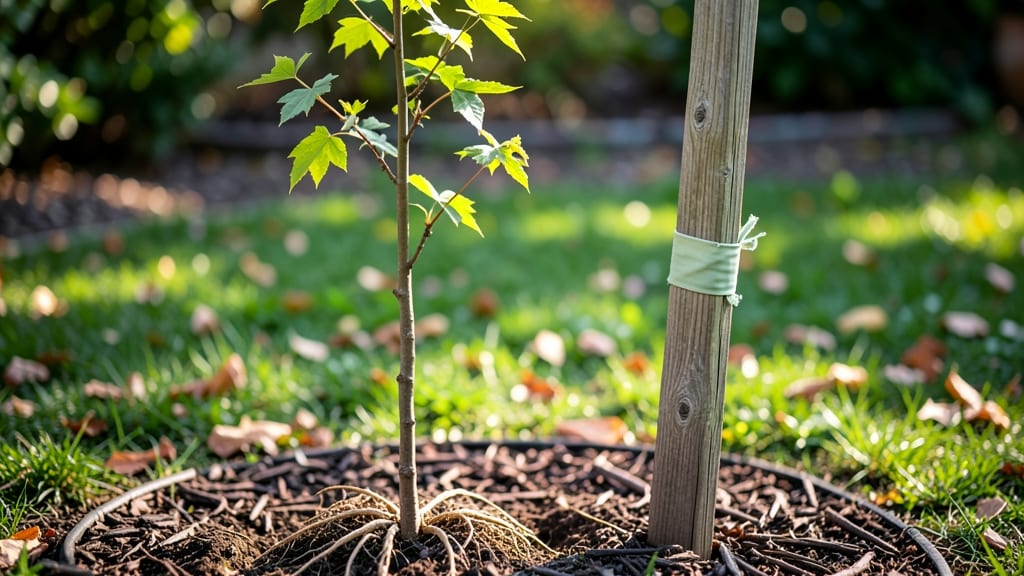
To stake a tree to grow straight, plant a sturdy support at a 45-degree angle near the trunk, secure it loosely with soft ties, and monitor regularly to avoid damaging the trunk as the tree develops.
Staking provides structural support while allowing the tree to develop its own strength over time. 🌳 The 45-degree angle distributes wind pressure evenly, preventing the trunk from bending permanently.
I've found that using soft, breathable ties—like tree straps or old T-shirts—reduces the risk of girdling, where the stake cuts into the bark as the tree grows.
For young trees, stakes should stay in place for 1-2 years, but always check them seasonally to ensure they're still effective without restricting growth.
Different tree species have unique needs—fruit trees often require staking longer than ornamental varieties due to their heavier branches. 🌿 Plastic stakes are durable but can be less flexible than bamboo, which bends slightly with wind.
The key is balancing support with natural movement; too much rigidity can actually weaken the tree's ability to develop a strong trunk on its own.
💡 In This Article
- How Tree Staking Prevents Bending and Wind Damage
- Best Staking Materials and Techniques for Different Tree Types
How tree staking prevents bending and wind damage
Young trees develop a weak trunk because their vascular cambium—the growth layer between bark and wood—isn't fully hardened. When winds exert force, this soft tissue can bend permanently, creating a crooked trunk. Stakes act like a temporary scaffold, redirecting wind pressure away from the vulnerable cambium layer.
The 45-degree angle is critical because it mimics how trees naturally lean slightly in storms, distributing force more evenly than vertical stakes. Without support, even gentle breezes can cause irreversible bending, especially in species like willows or poplars that grow quickly but with flexible stems.
The cambium tissue is particularly sensitive to constriction. When stakes are too tight or made of rigid materials, they can actually damage this layer as the tree grows, a condition called girdling. This happens because the expanding trunk presses against the stake, creating deep grooves that restrict nutrient flow.
I've seen this most commonly with metal stakes or poorly tied plastic ones.
The solution is using soft, stretchable ties that allow for about 1/8-inch of movement—just enough to prevent bending but not enough to restrict growth. 🌿 For example, a 3-inch wide tree strap can expand slightly as the trunk thickens, maintaining that critical gap.
Timing is everything when it comes to removing stakes. Most arborists recommend leaving them in place for 1-2 years, but this varies by species. Fruit trees like apples or cherries often need longer support because their branches create more wind resistance.
Ornamental trees, however, can sometimes be removed after just 6-12 months if they've developed sufficient trunk strength. The key is testing the tree's stability by gently pushing it—if it resists bending without support, it's ready for stake removal.
Removing stakes too early can lead to sudden bending, while leaving them too long can create dependency on artificial support.
Wind patterns also play a surprising role in staking effectiveness. Trees planted in exposed areas experience more lateral force than those in sheltered spots. In open fields, stakes should be placed on the prevailing wind side (usually west or southwest in temperate climates) to absorb the brunt of the pressure.
For urban plantings where wind comes from multiple directions, using two stakes at opposite angles (like a diamond shape) provides better stability. The stake's depth matters too—it should extend at least 18 inches into the soil to prevent toppling during storms.
What most people don't realize is that proper staking actually strengthens the tree's internal structure. When stakes prevent excessive bending, the tree allocates more energy to thickening its trunk rather than compensating for weak growth patterns.
This creates what arborists call "compression wood" on the windward side—denser, stronger wood that naturally forms in response to pressure. Over time, this makes the tree more resilient to future storms.
The goal isn't just to grow a straight trunk, but to build a tree that can stand on its own without permanent support.
Seasonal considerations affect staking too. Planting stakes in early spring (before bud break) gives roots time to establish before summer winds test the tree's stability. Fall planting is riskier because winter storms can exert unexpected force on newly planted trees.
For container-grown trees, which often have root-bound systems, staking should begin immediately upon planting to prevent toppling from wind or even curious pets. The first few weeks are critical—this is when most staking failures occur if the system isn't properly installed.