
Planting
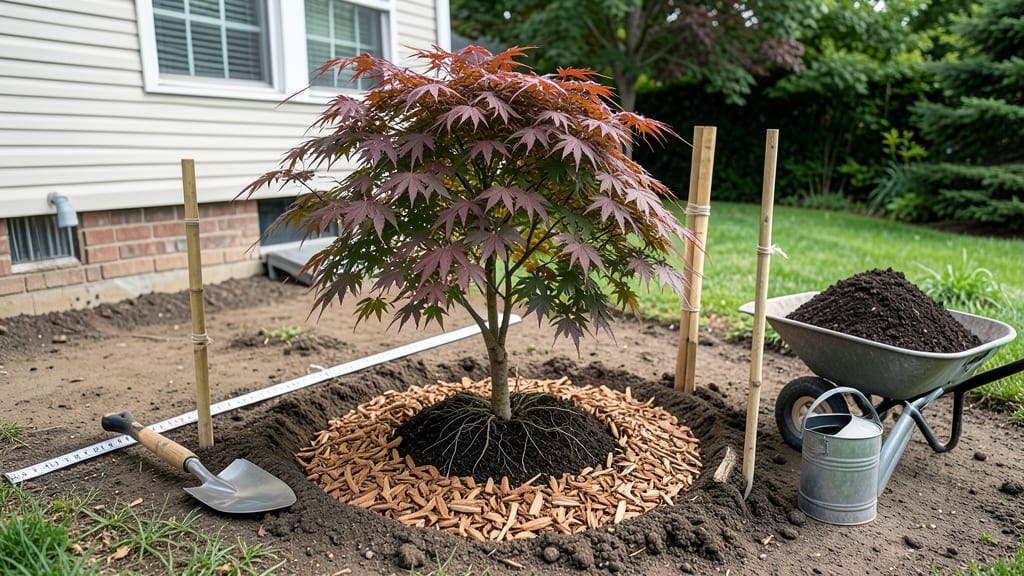
Planting a Japanese Maple tree too close to your house can damage your foundation, block sunlight for other plants, or even threaten your home’s structural integrity—but getting the spacing wrong is just as risky.
Picture this: a stunning Japanese Maple you’ve waited years to plant, only to watch its roots crack your driveway or its branches scrape your roof. The good news? With the right distance, you can have both beauty and safety.
Most experts recommend keeping it at least 10-15 feet from your foundation, but the exact number depends on your tree’s mature size and soil type.
Beyond foundation safety, sunlight and airflow play a huge role. A Japanese Maple needs partial shade—too close to a south-facing wall, and you’ll end up with scorched leaves.
Meanwhile, dwarf varieties (like Acer palmatum) can handle tighter spaces, while larger types (Acer japonicum) need room to spread their roots.
In this guide, I’ll break down the exact spacing rules by tree size, soil conditions, and local regulations—so you can plant with confidence and avoid costly mistakes down the road.
Japanese maple planting distance rules: foundation safety & root spread guidelines
Japanese maples (Acer palmatum and Acer japonicum) are stunning additions to any landscape, but their placement near your home requires careful planning. The root spread and mature size of these trees demand proper spacing to protect your foundation, septic systems, and underground utilities.
Planting too close can lead to root damage or even structural risks, while spacing too far may limit their aesthetic appeal.
Most Japanese maples have a spreading root system that extends 2-3 times their mature height. For example, a 15-foot tree may need 30-45 feet of clearance from your foundation.
Smaller dwarf varieties still require 10-15 feet of space to thrive without competition. Understanding these planting distance rules ensures your tree grows beautifully while safeguarding your home.
Key factors to consider include:
- Tree variety (dwarf vs. standard)
- Soil drainage (avoid waterlogged areas)
- Foundation type (concrete vs. brick)
- Local climate (root growth varies by region)
For concrete foundations, maintain at least 15 feet of clearance from the tree’s trunk to avoid root pressure against your home’s footings. Japanese maples have aggressive lateral roots, which can infiltrate cracks and disrupt drainage.
If your home has a septic system, plant the tree at least 50 feet away to prevent root intrusion into pipes or drainage fields.
Underground utilities like water lines or electric cables also require caution. Call 811 before digging to mark buried lines, then plant your Japanese maple 10 feet away from these utilities.
Even small roots can damage pipes over time, leading to costly repairs. Always measure twice before planting to avoid future headaches.
Soil type plays a critical role in root behavior. Japanese maples prefer well-draining, slightly acidic soil (pH 5.0-6.5). Heavy clay soils can slow root growth and increase the risk of root rot, while sandy soils may require additional mulching to retain moisture.
Amend your soil with organic matter like compost to improve drainage and encourage healthier root development.
When selecting a planting spot, consider the tree’s mature canopy spread. Most Japanese maples have a spreading habit, so avoid planting near driveways, patios, or sidewalks where roots could lift pavement.
If space is limited, choose a dwarf variety like Acer palmatum 'Emperor 1' and plant it 12-15 feet away from structures. Always stake young trees to prevent leaning toward your home.
Pro tip: Use a tree well or root barrier if planting near your foundation. These protective barriers (made of corrugated metal or plastic) redirect roots downward while allowing oxygen and water to reach them. Install the barrier 2 feet deep and 1 foot away from the trunk
Sunlight & airflow needs: how close can you plant near windows or walls?
Japanese maples thrive near windows and walls—but only if you get the spacing right. Too close, and you’ll smother their delicate foliage or risk leaf scorch from reflected heat. Too far, and they’ll lose their dramatic silhouette against your home’s architecture.
The ideal distance balances 4-6 hours of morning sun with afternoon shade, especially for variegated cultivars like 'Bloodgood' or 'Shishigashira'.
Walls act as windbreaks, reducing airflow that’s crucial for disease prevention. Without proper circulation, your tree may develop powdery mildew or leaf spot. East-facing walls are safest—they provide gentle morning light while shielding from harsh afternoon rays.
South-facing walls? Keep your maple at least 15 feet away to avoid overheating.
Windows complicate things further. Glass reflects up to 30% more UV radiation, which can bleach leaves or cause sunburn. If planting near a window, position your tree 10-12 feet back and use sheer curtains to diffuse light.
For dwarf varieties like 'Emperor I', reduce this to 6-8 feet—but monitor closely for stress signs like yellowing edges.
Planting Japanese Maple Near Walls/Windows
✅ Pros
- Enhanced curb appeal – Frames windows beautifully
- Natural shade – Cools home in summer
- Wind protection – Reduces leaf damage
- Year-round interest – Color changes with seasons
❌ Cons
- Risk of overheating – South-facing walls cause leaf scorch
- Reduced airflow – Increases fungal diseases
- Root competition – May damage foundation if too close
- Light intensity issues – Variegated leaves may revert to green
Seasonal adjustments are key. In summer, your maple may need afternoon shade from a nearby wall, while winter’s weak sun means it’ll crave maximum exposure.
For solid-leaf varieties like 'Butterfly', this flexibility is less critical, but variegated types (with white/pink edges) demand precise light control to maintain their color contrast.
Consider your tree’s mature canopy width—most Japanese maples spread 15-25 feet at maturity. Planting too close to a wall risks root binding, where roots circle the trunk instead of growing outward.
This weakens structural integrity and makes pruning difficult. Always dig a test hole to check for compacted soil or underground obstacles before planting.
If your space is limited, opt for dwarf cultivars like 'Crimson Queen' or 'Orangeola'. These stay under 10 feet tall and can thrive 8-10 feet from walls, but still require daily airflow.
Pair them with low-growing shrubs like boxwoods to create a layered look without crowding. Just remember: health always wins over aesthetics—a struggling tree is no decorative statement.