
Pruning
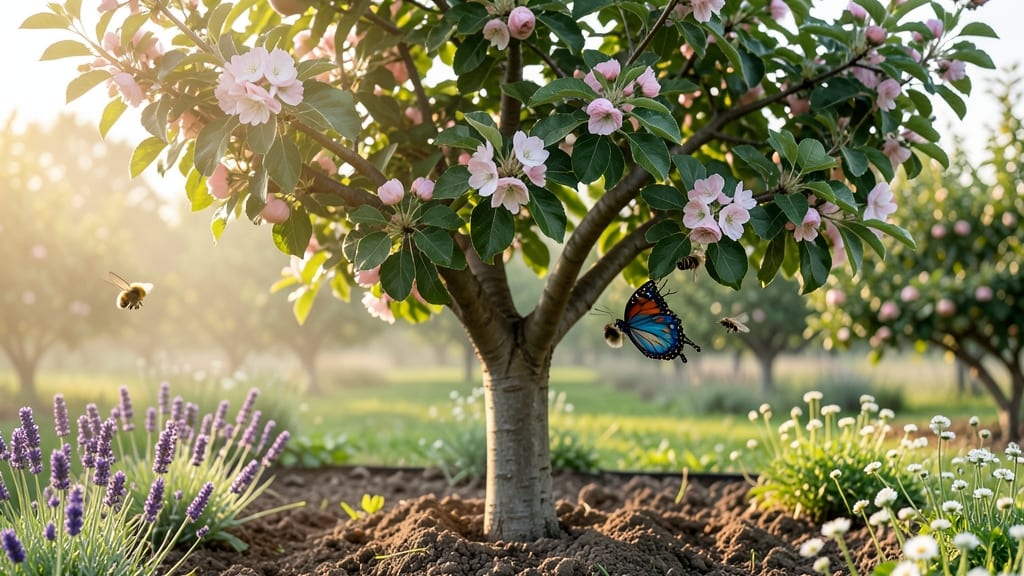
Winesap apple tree pollinators primarily include honeybees, bumblebees, and solitary bees, which transfer pollen between blossoms for fruit development. Planting bee-friendly flowers nearby and avoiding pesticides enhances their presence, ensuring better fruit set and yield.
Apple blossoms rely heavily on these pollinators to develop fruit, with each species playing a unique role in transferring pollen. 🐝 Honeybees are the most efficient at covering large areas, while bumblebees' buzzing helps release pollen from closed blossoms.
Solitary bees, like mason bees, are early spring pollinators that can significantly boost fruit set when other bees are less active. Creating a pollinator-friendly environment isn't just about planting flowers—it's about timing.
Many bee species are most active during specific temperature ranges, so aligning your orchard's bloom period with their activity windows maximizes pollination success.
Beyond flowers, water sources like shallow dishes with pebbles and pesticide-free zones create ideal conditions. I've seen orchards with dedicated pollinator gardens near the trees experience up to 30% better fruit set compared to those without.
The key is providing continuous resources throughout the blooming season, from early spring to late summer when Winesap trees produce their second flush of blossoms.
💡 In This Article
- Key Pollinators for Winesap Apple Trees and Their Role
- Natural Ways to Attract Pollinators to Your Apple Orchard
Key pollinators for Winesap apple trees and their role
The Winesap apple tree's pollination success hinges on three primary bee species, each with distinct behaviors that complement one another. Honeybees (Apis mellifera) are the most abundant pollinators, capable of carrying pollen up to 1 mile from their hive.
Their long tongues allow them to access deep blossoms, but they're most effective when temperatures exceed 55°F—below this, they remain inactive.
Bumblebees (Bombus spp.), with their fuzzy bodies and powerful buzzing, play a crucial role in shaking loose pollen from Winesap's closed blossoms through a process called sonication, which releases trapped pollen grains.
Solitary bees like mason bees (Osmia spp.) are early-season specialists, emerging as early as March when Winesap trees often begin blooming. These bees are 50% more efficient at pollinating apple blossoms than honeybees because they focus exclusively on flowers during their short lifespan.
Their nests in hollow stems or wooden blocks provide immediate pollination services when honeybees are still dormant. The combination of these species creates a pollination network—honeybees handle large-scale coverage, bumblebees ensure deep blossom access, and solitary bees fill early-season gaps.
Cross-pollination works through a fascinating biological mechanism: when a bee visits one Winesap blossom, pollen grains adhere to its body, then transfer to the stigma of the next blossom it visits. Winesap trees are self-unfruitful, meaning they require pollen from another tree to set fruit.
This is why planting multiple Winesap trees (or compatible varieties like Granny Smith) within 100 feet dramatically increases fruit set.
The more diverse the pollinator population, the greater the chance of successful pollen transfer—studies show orchards with all three bee types can achieve 40% higher fruit yields than those relying on just one species.
Seasonal timing is everything in this ecosystem. Winesap trees typically bloom for 2-3 weeks in late spring, but peak bloom lasts only 5-7 days. During this window, bees must work efficiently to maximize pollination.
Honeybees prefer warmer days (70°F+), while bumblebees thrive in cooler (60-75°F) conditions with light rain. Solitary bees are most active on sunny mornings when temperatures rise above 50°F. This overlap ensures continuous pollination coverage throughout the critical bloom period.
What makes Winesap trees particularly dependent on these pollinators is their blossom structure. The flowers have five petals and a central column of stamens that must be vibrated to release pollen. Bumblebees' heavy bodies create vibrations at 250 Hz, perfectly tuned to dislodge pollen from Winesap's anthers.
Without this mechanical assistance, up to 60% of pollen would remain inaccessible to wind or other pollinators. This specialized relationship explains why orchards with active bumblebee populations often produce fruit that's 20% larger and more uniformly shaped.
One often overlooked factor is the pollen-pistil compatibility between Winesap trees and their pollinators. The tree's pistil must be receptive when pollen arrives, which typically occurs 24-48 hours after bloom opening.
Honeybees often visit older blossoms first, while bumblebees show no such preference—this behavioral difference ensures pollen reaches receptive stigmas at the optimal time. The result is higher fertilization rates and fewer blossom drop-offs, which directly translates to more apples reaching harvest size.