
Plants
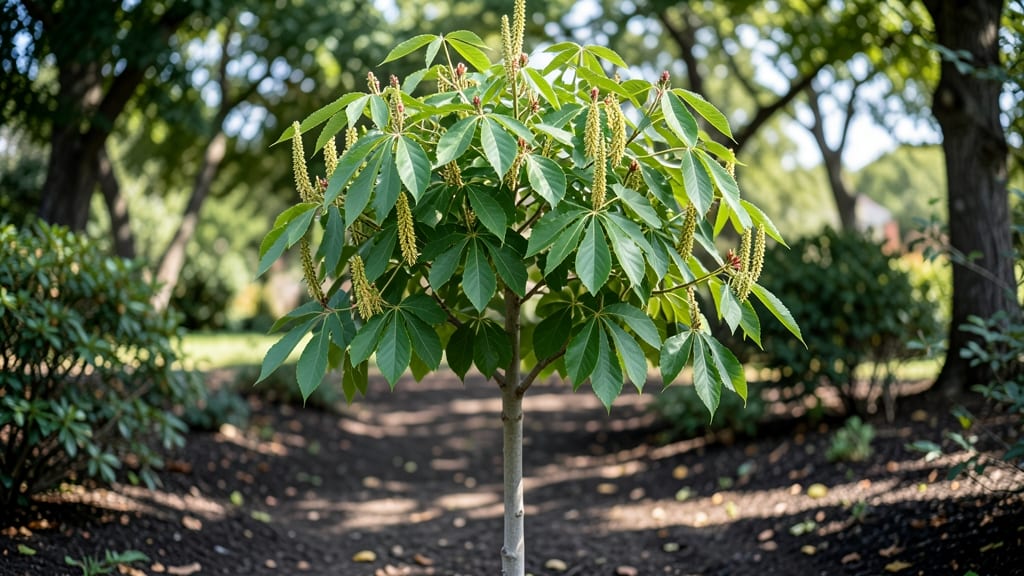
A young walnut tree looks like it has distinctive maple-like leaves with deep lobes and jagged edges, paired with smooth gray bark and clustered leaf formations. The sapling grows with delicate stems and a gradual upward reach, featuring fuzzy terminal buds and fine hairs on fresh growth.
A young walnut tree's most striking feature is its compound leaves that grow in clusters of 5-9 leaflets, each with serrated edges and a glossy finish. 🌿 These leaflets resemble maple foliage but are more delicate, with a lighter green hue that darkens as the tree matures.
The bark remains smooth and grayish-brown during early years, unlike older walnut trees that develop deep furrows. What sets young walnuts apart is their growth pattern—slender branches with fuzzy new shoots that help distinguish them from similar trees like hickory or butternut.
These visual clues make identification straightforward for gardeners. The terminal buds appear slightly hairy, and the overall growth habit is upright but spreading gradually. Morning sunlight enhances the leaves' vibrant color, while proper spacing (at least 20 feet apart) prevents overcrowding during the critical first three years.
Understanding these characteristics helps you spot young walnut trees in nurseries or wild settings with confidence.
💡 In This Article
- Identifying Walnut Tree Leaves and Bark in Early Growth
- Growth Habits and Care for Young Walnut Saplings
Identifying walnut tree leaves and bark in early growth
The leaves of a young walnut tree are its most distinctive feature, with each compound leaf containing 5-9 leaflets arranged alternately along the stem. These leaflets have a unique lobed shape with serrated edges, resembling miniature maple leaves but with finer details.
The central leaflet is typically the largest, measuring about 2-4 inches long, while the smaller side leaflets create a symmetrical, fan-like appearance. 🌿 The upper surface is a rich, glossy green, while the underside often shows a lighter, slightly fuzzy texture—especially noticeable in the spring when new growth emerges.
The bark of a young walnut tree starts smooth and grayish-brown, almost silvery in bright light, with a slightly rough texture that develops subtle ridges as the tree ages. This early-stage bark lacks the deep furrows seen on mature walnut trees, which can help distinguish it from older specimens.
One key detail is the presence of lenticels—small, raised pores that allow gas exchange—scattered along the bark, giving it a speckled appearance when viewed closely. These characteristics set walnut apart from similar trees like hickory (which has more pronounced ridges) or butternut (with a more yellowish bark).
What makes identification even easier is the tree's terminal buds, which are slightly fuzzy and elongated, measuring about 1/4 to 1/2 inch. These buds appear at the tips of branches and often have a reddish-brown hue, contrasting with the green stems.
New shoots also feature fine, silky hairs that disappear as the tree matures. This combination of leaf structure, bark texture, and bud morphology creates a visual profile that's hard to confuse with other hardwood saplings. 🌱
When comparing walnut to hickory, observe the leaf arrangement: walnut leaves grow in clusters directly from the stem, while hickory leaves have a more staggered pattern.
Butternut trees, on the other hand, produce compound leaves with 11-17 leaflets (more than walnut), and their bark tends to develop a more yellowish tint as they age.
These distinctions become clearer during the spring and summer months when leaf growth is most active, making it the ideal time for identification.
Another helpful trick is to examine the leaf margins under bright light—the serrations on walnut leaves have tiny, sharp points that create a saw-like appearance when viewed closely.
This feature, combined with the tree's upright growth habit and the way its branches spread at wider angles, creates a distinctive silhouette that even novice gardeners can recognize. 🌳 For those in temperate climates, young walnut trees typically reach 10-20 feet tall by their third year, with a trunk diameter of about 2-3 inches.