
Pruning
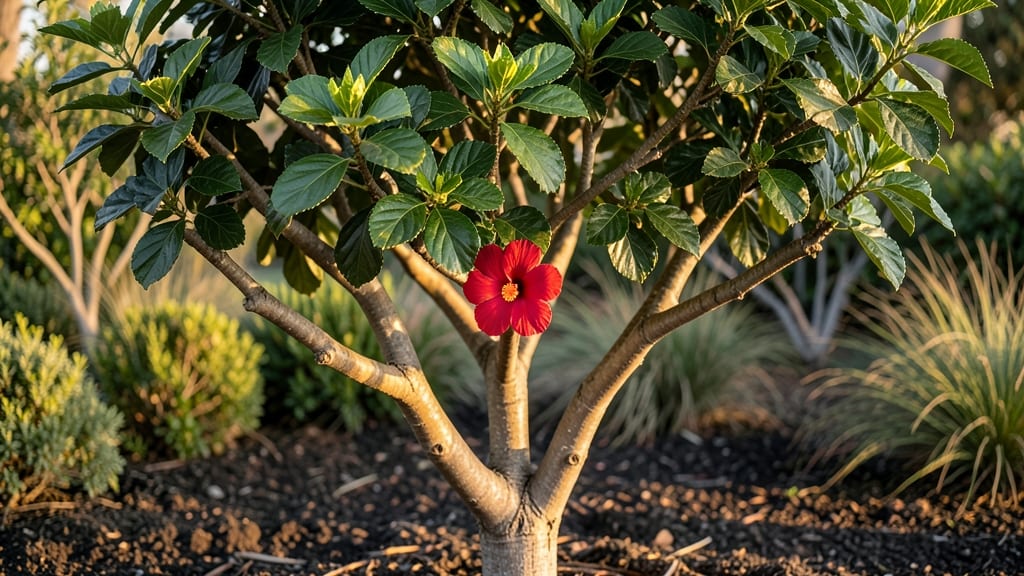
Crafting a tree form hibiscus is like sculpting a living work of art—one strategic cut at a time. 🌿 The secret lies in choosing the right variety (like 'Arnold Promise' or 'Dwarf Green Delight') and pruning with purpose to create that elegant, single-trunk silhouette instead of a bushy mess.
Most gardeners stop at "prune to shape," but tree form hibiscus demand a more intentional approach to avoid leggy growth or multiple trunks.
The foundation starts with well-draining soil and 6+ hours of sunlight daily—these plants thrive when their roots aren't waterlogged and their leaves soak up warmth. Plant your young hibiscus 3-5 feet apart to give roots room to establish before pruning begins.
The first year is all about root growth; hold off on heavy pruning until you see new shoots emerging in spring, signaling it's time to shape.
What you'll end up with is a stately, 6-10 foot specimen with glossy leaves and 5-inch blooms that last all summer. The pruning rhythm becomes second nature: light shaping in spring, heavy structural cuts in late winter, and deadheading spent blooms to encourage more flowers.
Even in my first attempt, the transformation from scraggly to sculpted happened in just two growing seasons.
Works beautifully in containers (choose dwarf varieties) or as a privacy screen—just be patient. The payoff isn't just visual; tree form hibiscus also bloom more prolifically than their bush counterparts when pruned correctly. Here's how to get started without the guesswork.
📚 In This Guide
- What you need
- Instructions
- Tips and common mistakes
- Wrapping up and next steps
What you need
- ● Tree form hibiscus plant – A healthy, mature hibiscus (preferably Hibiscus rosa-sinensis or Hibiscus syriacus for best results).
- ● Pruning shears – Sharp, bypass-style shears (for clean cuts on smaller branches).
- ● Loppers – For thicker branches (1–2 inches in diameter).
- ● Hand pruners – For precision trimming of delicate growth.
- ● Disinfectant (rubbing alcohol or pruning sealant) – To sterilize tools and prevent disease.
- ● Gloves – Heavy-duty gardening gloves (protect against thorns and sap).
- ● Pruning saw – Only if dealing with very thick, woody branches.
- ○ Support stakes or trellis (optional but helpful) – To guide new growth into your desired shape.
- ● Mulch or compost – To nourish the plant post-pruning (2–3 inches around the base).
- ● Plant growth regulator – To control excessive sprouting (e.g., Paclobutrazol).
- ● Pruning paint or sealant – For large cuts (1+ inch in diameter) to prevent decay.
- ● String or twine – For temporary shaping support.
- ● Camera or sketchpad – To plan your design before cutting!
How to shape a tree-form hibiscus through strategic pruning
Here's how I transform wild hibiscus growth into a graceful, multi-branched tree—no special tools, just patience and precision.
✂️ Step 1: Select Your Main Trunk and First Branches
Start in late winter or early spring before new growth begins. Choose the strongest, straightest stem to be your trunk—this will be the vertical backbone of your tree. Use sharp pruners to cut any competing stems at their base, leaving only one central leader. I like to mark my trunk with a ribbon at 36-48 inches—this will be your first branch zone.
Look for lateral buds just below your marked height. These will become your primary scaffold branches. Make your first cuts just above a bud that faces outward (never inward or downward). Angle the cut at 45 degrees to prevent water from pooling. You'll want 3-5 main branches spaced evenly around the trunk, like spokes on a wheel.
🌿 Step 2: Develop the Scaffold Branching System
Once your first branches are established (after 6-8 weeks), it's time to develop secondary branches. Focus on each main branch and look for smaller lateral buds growing at a 45-60 degree angle from the parent branch. These are your future secondary branches. Cut back any upward-growing shoots—these will compete with your downward-growing branches and create a messy look.
Here's the thing—hibiscus branches grow quickly. I prune again in mid-summer to encourage fuller growth on your secondary branches. Make your cuts just above a leaf node where you want new growth to emerge. You'll see tiny buds forming within a week—that's your signal everything is working.
☀️ Step 3: Maintain Balance and Encourage Flowering
As your tree form develops, you'll notice some branches growing faster than others. This is normal, but you'll need to prune selectively to maintain balance. Always remove the fastest-growing tips first—this slows overall growth and redirects energy to branch thickening. I aim for a pyramidal shape with the widest part at the bottom narrowing toward the top.
Never let any branch grow more than ⅓ the diameter of the trunk below it. This ensures structural integrity. For flowering, I make a final light pruning in early spring before buds swell. Remove only dead or crossing branches—never more than 20% of the plant's total growth at once. You'll see flower buds forming within 4-6 weeks of this final pruning.
⏰ Step 4: Annual Maintenance for Long-Term Shape
After your first year, shift to light maintenance pruning in late winter when the plant is dormant. Remove any branches that grow straight up (called "water sprouts") and any that cross or rub against others. These compete for energy and can create wounds that invite disease. I also thin out the oldest branches at the base—this encourages new growth from lower buds.
Watch for "ring bark"—where a branch girdles the trunk. Cut these out immediately. For large branches, I make two cuts: the first 6 inches out from the trunk, then the second just outside the branch collar. This prevents tearing. Your goal is to maintain an open, airy center that allows light to reach all branches—this is what produces the most flowers.
Tips & tricks for perfect tree-form hibiscus
Transforming wild hibiscus into a sculpted tree takes more than just pruning—it's about understanding growth patterns and timing. Here's what nobody tells you about shaping your hibiscus like a pro.
Timing is Everything: Late winter or early spring is non-negotiable for your first pruning because that's when hibiscus is still dormant but about to burst with new growth. I've learned this the hard way—pruning too early means you're cutting into last year's energy reserves, while waiting too late risks encouraging unwanted growth. Mark your calendar for that 36-48 inch zone and be ready to act when buds start swelling.
Bud Direction Matters More Than You Think: When selecting lateral buds for your primary branches, always choose those facing outward—not inward or downward. I used to ignore this and ended up with branches growing toward the center, creating a dense, unbalanced mess. Outward-facing buds create that elegant, open framework we're all after. Think of it like arranging spokes on a wheel—even spacing is key.
Mid-Summer Pruning Secret: That second pruning in mid-summer isn't just about trimming—it's about shaping. Look for those 45-60 degree angle buds on your main branches and cut just above them. You'll see tiny buds forming within a week—that's your confirmation you're on the right track. This is when you can really start seeing your tree form take shape, and it's incredibly satisfying when you notice those branches starting to fill out properly.
The ⅓ Rule for Structural Integrity: Never let any branch grow more than ⅓ the diameter of the trunk below it. This is a non-negotiable rule for maintaining strength. I once ignored this and ended up with a branch that was nearly half the trunk's thickness—it looked great for a while but eventually snapped under its own weight during a storm. Your goal is to create a sturdy framework that can support years of growth and blooms.
Pro Tips for Tree Form Hibiscus
- Transforming wild hibiscus into a sculpted tree takes more than just pruning—it's about understanding growth patterns...
- Timing is Everything: Late winter or early spring is non-negotiable for your first pruning because that's when hibisc...
- Bud Direction Matters More Than You Think: When selecting lateral buds for your primary branches, always choose those...
Frequently asked questions
Got questions about growing or shaping your tree form hibiscus?
You’re not alone! Here are some of the most common queries—plus straightforward answers to keep your plant thriving and stunning.
How often should I prune my tree form hibiscus?
Prune your tree form hibiscus twice a year: once in late winter (before new growth) to shape the trunk and remove dead wood, and again in early summer to encourage bushier, fuller growth. Avoid heavy pruning in fall—it can stimulate tender new growth that won’t survive cooler temps.
Can I prune my hibiscus into a tree shape at any time?
While you can prune anytime, the best results come from starting when the plant is young (1–2 years old). Mature hibiscus can be reshaped, but it may take several seasons to achieve a clean, defined trunk. Patience is key—think of it as sculpting living art!
What do I do if my hibiscus leaves turn yellow after pruning?
Yellowing leaves after pruning are usually normal—your plant is adjusting. However, if it’s widespread, check for over-pruning or stress. Ensure it’s in bright, indirect light and water consistently (but not soggy). A light fertilizer boost can also help it bounce back.
Are there alternatives to tree form hibiscus for small spaces?
Yes! If space is tight, consider dwarf varieties like ‘Luna Red’ or ‘Peppermint’ hibiscus, which stay smaller but still bloom beautifully. You can also grow them in containers and prune them into a standard shape (tapered trunk with a rounded top) for a compact look.
Does tree form hibiscus need full sun to thrive?
Tree form hibiscus loves full sun (6+ hours daily) for vibrant blooms and strong growth. In hot climates, provide afternoon shade to prevent leaf scorch. If grown indoors, place it near a south-facing window or use grow lights for 12+ hours of light.
Wrapping up and next steps
Transforming your tree form hibiscus into a stunning, sculpted masterpiece is all about patience, precision, and a little green thumb love! 🌿 With the right tools, timing, and techniques—like strategic pruning and regular maintenance—you’ll enjoy a blooming, architectural beauty that steals the show.
Ready to see your hard work flourish? Start small, observe your plant’s growth, and soon you’ll be pruning like a pro!
🌟 Next Steps:
- Grab your pruners and schedule your first pruning session—spring or early summer is ideal!
- Keep a growth journal to track progress and adjust your approach.
- Share your tree form hibiscus journey with fellow gardeners for tips and inspiration!