
Propagation
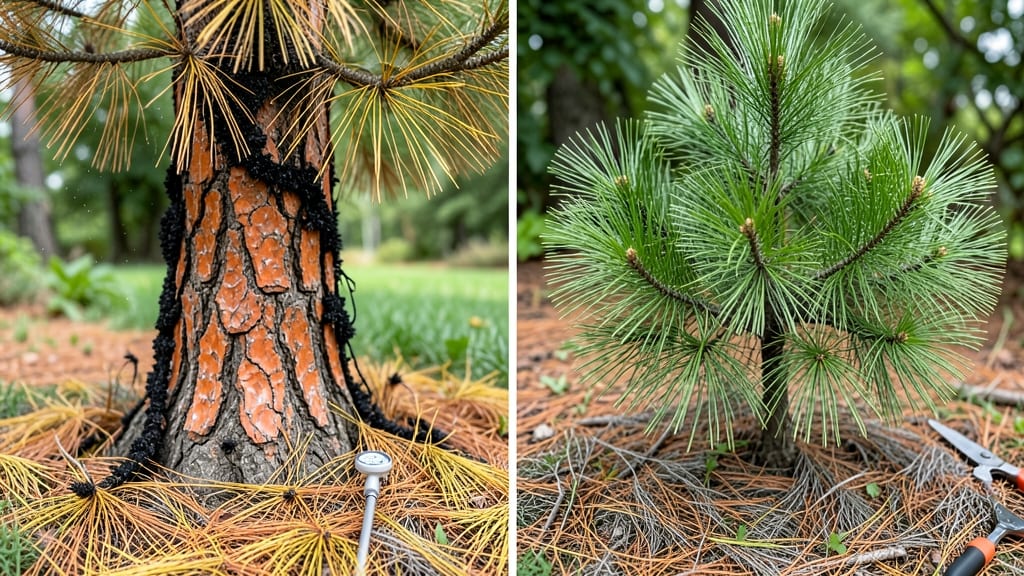
When your pine tree is dying from the top down, it’s not just bad luck—it’s a cry for help from the roots. 🌲 The most common culprits are root rot (often from Fusarium or Armillaria fungi) and environmental stress, but the good news is you can still save it with the right pruning and care.
I’ve nursed back more than a few "dead" pines using these science-backed steps, and the key is acting fast before the disease spreads.
The first sign is yellowing needles at the top, followed by browning branches that snap easily. This isn’t just age—it’s a fungal infection choking the tree from the inside out.
The roots rot first, cutting off water and nutrients, and the tree’s last defense is to shed the highest (weakest) branches. But if you catch it early, pruning the dead top and improving drainage can stop the spread and let new growth take over.
You’ll start by removing only the dead branches (no live wood!) with sterilized pruners, then focus on fixing the soil. Amend compacted areas with compost, avoid overwatering, and consider a fungicide like copper fungicide for severe cases.
Within a season, you’ll see fresh green needles pushing from lower branches, proving the tree’s still fighting—and with your help, it can win.
This works for both container and in-ground pines, from dwarf varieties to towering Scots pines. The secret? Patience and precision. Skip the heavy-handed pruning—focus on the science of selective cuts and root health. Your tree’s future depends on it.
Hidden Causes Behind Top-Down Death
When your pine tree starts losing its needles from the top down, it’s often a silent scream for help—long before the symptoms become obvious. Understanding the why behind this pattern is the first step to saving your tree.
Below, we break down the most common culprits, backed by science, so you can diagnose the issue accurately and act fast.
Pine trees are resilient, but prolonged drought or extreme heat can push them past their limits. When roots struggle to pull up enough water, the tree prioritizes survival by shutting down the oldest (topmost) needles first—a survival mechanism called abscission.
- How it happens: High temperatures increase transpiration (water loss through needles), while shallow or compacted soil prevents moisture uptake.
The tree’s vascular system can’t keep up, leading to hydraulic failure in the crown. - Actionable signs: - Needles turn yellow or brown from the tips inward. - Soil feels bone-dry 2–3 inches deep. - The tree is in full sun with no shade or windbreak. - 💡 Pro Tip: Test soil moisture with a screwdriver—if it resists, your tree is thirsty. Deep watering (1–2 inches per week) and mulching (2–4 inches of organic mulch) can restore balance.
Fungi like Armillaria root rot or Leptographium wageneri (a common pine pathogen) thrive in stressed trees. These organisms clog the tree’s xylem (water-conducting tubes), blocking nutrient flow. Since the top is farthest from the roots, it’s the first to show symptoms.
- How it happens:
- Armillaria spreads via root grafts between trees, creating a "fairy ring" of decay.
- Leptographium enters through pruning wounds or bark injuries, then moves upward.
- Actionable signs:
- Shelf fungi at the base (Armillaria).
- Black streaks in the sapwood when cut.
- Sudden needle drop in hot weather (fungi accelerate in heat).
- 🔥 Warning: If you see mushrooms at the base or dark, stringy roots, the tree may be beyond saving. Remove and replace to prevent spread.
Pine trees hate soggy feet. When soil stays waterlogged, root rot (caused by Phytophthora or Pythium fungi) sets in, suffocating roots and cutting off water supply. The tree responds by shedding needles from the top down, where resistance is lowest.
- How it happens:
- Compacted or clay soil traps moisture.
- Overzealous watering (e.g., daily hoses) drowns roots.
- Improper planting (too deep or in low spots) traps water.
- Actionable signs:
- Mushy, discolored roots when dug up.
- Needles stay green but fall easily (unlike drought, where they brown).
- Soil smells sour or has a grayish hue.
- 🌡️ Fix It: Improve drainage with sand or gravel amendments, avoid watering until the top 2 inches of soil are dry, and raise the root flare if planted too deep.
Insects like pine bark beetles, pine needle scale, or white pine weevils target the cambium layer (the tree’s growth ring). When they bore into the top branches, they disrupt the phloem (food transport system), starving the crown.
- How it happens:
- Bark beetles (e.g., Dendroctonus) lay eggs under bark, killing phloem.
- Needle scale sucks sap, weakening branches.
- Weevils chew on terminal buds, causing dieback.
- Actionable signs:
- Sawdust-like frass at the base of branches.
- Pitch tubes (beetle exit holes) on bark.
- New growth stunted or missing entirely.
- ✨ Solution: Apply systemic insecticides (like imidacloprid) in early spring, or prune and burn infested branches to prevent spread.
Pine trees need nitrogen, phosphorus, and micronutrients like magnesium and manganese. A deficiency in these can cause chlorosis (yellowing) and premature needle drop, often starting at the top where demand is highest.
- How it happens: - Soil pH too high (alkaline >7.0) locks out iron and manganese. - Over-fertilizing with nitrogen burns roots, reducing uptake. - Poor soil structure limits microbial activity, reducing nutrient availability. - Actionable signs: - Yellow needles between veins (iron/manganese deficiency). - Purple stems (phosphorus deficiency). - Slow growth despite adequate water. - 💪 Fix It: Test soil pH—aim for 5.0–6.5.
Apply chelated iron or Epsom salt (magnesium sulfate) if deficient. Avoid synthetic fertilizers; opt for slow-release organic amendments like composted pine bark.
Mechanical stress from storm damage, hail, or aggressive pruning can sever vascular connections in the crown. When the tree’s "plumbing" is compromised, the top—being the most exposed—suffers first.
- How it happens:
- Top-heavy trees in windy areas experience snap stress.
- Improper pruning cuts (too close to the trunk or jagged) create entry points for disease.
- Hail or ice crushes needles, increasing water loss.
- Actionable signs:
- Broken branches with smooth, clean breaks (wind).
- Sunken or calloused pruning wounds (poor cuts).
- Needles torn, not dried out.
- 🔪 Prevention: Prune in late winter (dormant season), use clean, sharp tools, and thin the crown to reduce wind load. Stake young trees in high-wind areas.
Some pine varieties (like Scots pine or Mugo pine) are more susceptible to top dieback due to weak genetic resistance. If your tree is young (under 10 years) and healthy-looking except for the crown, it may simply be outgrowing its root system.
- How it happens:
- Slow root growth can’t support rapid top expansion.
- Container-grown trees often have root-bound systems.
- Actionable signs:
- No other stress factors (pests, disease, drought).
- Tree is young but top is disproportionately large.
- Roots are circling when dug up.
- 🌱 Solution: Transplant carefully with root pruning to encourage outward growth. Avoid over-fertilizing—focus on water and mulch to build roots gradually.
Revive Your Pine Tree Now
If your pine tree is showing signs of top-down decline, acting quickly can make all the difference. The good news? Most causes—whether fungal infections, pests, or environmental stress—have practical fixes.
Below, we break down the most effective solutions, tailored to the root cause, so you can nurse your tree back to health with confidence.
Root rot is often the sneakiest culprit behind a pine tree’s slow decline. If the soil stays soggy for too long, fungal pathogens like Phytophthora or Armillaria take hold, cutting off water and nutrient flow.
🔥 Step 1: Drainage Overhaul
Poor drainage is the #1 enemy of pine roots. If your tree is planted in heavy clay or a low-lying area, it’s time for a soil upgrade.
- 👨🍳 Amend the soil: Mix in coarse sand, perlite, or pine bark fines (20-30% of the existing soil) to improve aeration. Avoid compacting the amended soil—fluff it like cake batter!
- 🏗️ Raise the planting bed: If possible, mound the soil around the base to create a slight slope, encouraging water runoff.
- 💡 Pro tip: Install a French drain (a buried perforated pipe wrapped in gravel) around the perimeter if water pools persistently.
🍳 Step 2: Fungal Treatment
Once root rot sets in, fungicides can help slow its spread—but act fast.
- 🔪 Apply a systemic fungicide: Products like Propiconazole or Myclobutanil (found in brands like Bonide Copper Fungicide or Fungi-Nil) can penetrate the soil and inhibit fungal growth. Follow label instructions for dosage.
- 🌡️ Boost soil health: Add beneficial microbes like Mycorrhizal fungi (available in powder or granular form) to outcompete harmful pathogens.
⏰ Step 3: Prune Strategically
While root rot is below ground, above-ground pruning can reduce stress on the tree.
- ✂️ Remove dead or dying branches: Use sterilized pruning shears to cut back any brown, brittle limbs starting from the top. Dispose of these in a sealed bag—do not compost to avoid spreading disease.
- 🎯 Thin the canopy: If the tree is overly dense, open it up by removing 10-20% of the smallest branches to improve airflow and sunlight penetration.
Insects like pine bark beetles, sawflies, or spider mites can weaken a pine tree from the inside out, making it vulnerable to secondary infections.
🔥 Step 1: Identify the Culprit
Not all pests look the same. Check for:
- 🐜 Tiny holes in bark: Likely bark beetles.
- 🌿 Sawdust-like frass: Sign of sawfly larvae.
- 🕷️ Fine webbing: Spider mites are feeding on needles.
🍳 Step 2: Targeted Treatments
Use the right tool for the job:
| Pest | Treatment | When to Apply |
|---|---|---|
| Bark Beetles | Apply Bifenthrin (e.g., Ortho BugClear) or Neem oil to bark crevices. For severe cases, inject systemic insecticides like Imidacloprid. | Late spring to early summer (when beetles are active). |
| Sawflies | Spray Bacillus thuringiensis (Bt) (e.g., Dipel) or Spinosad (e.g., Captain Jack’s) on new growth. | Early spring before eggs hatch. |
| Spider Mites | Blast off mites with a strong spray of water, then apply Neem oil or horticultural oil. | During dry, hot spells (mites thrive in drought). |
💡 Pro Tip:
Encourage natural predators like ladybugs or parasitic wasps by planting companion plants (e.g., yarrow or dill) nearby.
Heat, drought, or poor soil can weaken a pine tree, making it susceptible to top-down decline. Adjusting care can turn things around.
🔥 Step 1: Water Wisely
Pines hate "wet feet" but also struggle in drought. Aim for:
- 💧 Deep, infrequent watering: Water slowly and deeply (1-2 inches per week) rather than shallowly. Use a soaker hose or drip irrigation to avoid wetting foliage.
- ⏰ Best time to water: Early morning (reduces fungal risks) or late evening (minimizes evaporation).
🍳 Step 2: Improve Soil Nutrition
Pines prefer acidic, well-draining soil (pH 4.5–6.0). Test your soil with a home kit or send a sample to a local extension office.
- 📊 Adjust pH if needed:
- Too alkaline? Add elemental sulfur or peat moss.
- Too acidic? Mix in lime (use sparingly—pines are sensitive!).
- 💪 Feed with pine-specific fertilizer: Use a slow-release, acidic fertilizer (e.g., Miracle-Gro Azalea, Camellia, & Rhododendron) in early spring and fall.
🌡️ Step 3: Shield from Stressors
Pines are tough but not indestructible. Protect yours from:
- 🔥 Extreme heat: Provide afternoon shade (especially for young trees) with shade cloth or plant near deciduous trees.
- 🌬️ Windburn: If your tree is exposed, mulch heavily (3–4 inches of pine straw or wood chips) to retain moisture.
- 🎯 Chemical damage: Avoid herbicides (especially glyphosate) near the
Frequently asked questions
Why does my pine tree always die from the top down instead of the bottom?
This pattern happens because the top branches are the most vulnerable to stress. When roots struggle (from drought, rot, or pests), the tree prioritizes survival by shutting down the oldest, farthest needles first. Think of it like a car cutting power to the radio when the engine overheats—sacrificing the least critical parts to save the core.
Can I save a pine tree if mushrooms are growing at its base?
Unfortunately, mushrooms like Armillaria indicate advanced root rot. The tree is likely beyond saving, but you can prevent spread by removing it immediately and treating the soil with copper fungicide. Plant new trees in that spot only after sterilizing the area with solarization (covering with clear plastic for 4-6 weeks).
How can I tell if my pine tree is dying from pests vs. disease?
Look for these clues: Pests leave visible damage like frass (sawdust-like debris), holes in bark, or webbing. Disease shows as black streaks in wood, shelf fungi, or sudden needle drop without other signs. For pests, check the underside of needles—tiny eggs or crawling insects confirm the culprit.
Is it safe to prune a dying pine tree to encourage new growth?
Yes, but only remove dead branches (they're brown, brittle, and snap easily). Never cut into live wood—this stresses the tree further. Use sterilized tools and make clean cuts just outside the branch collar. For severe cases, professional arborists recommend crown thinning (removing 10-20% of the smallest branches) to reduce stress.
How long does it take to see improvement after treating root rot?
With proper care, you may see new growth in 4-6 weeks, but full recovery can take 1-2 years. Monitor for green needles at the base—this is the first sign of recovery. Avoid overwatering during this time; deep, infrequent watering (every 7-10 days) helps roots reestablish without drowning them.