
Pruning
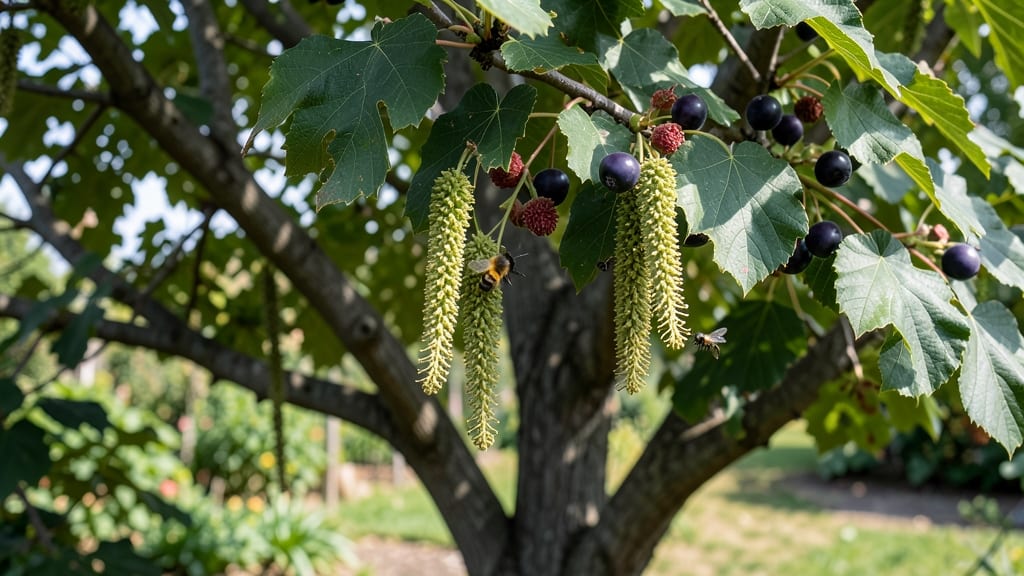
Mulberry tree pollination happens primarily through wind and insect activity, especially from bees, during the peak flowering season of late spring to early summer. Successful fruit production relies on cross-pollination, though some varieties can self-pollinate. Proper pruning and spacing enhance pollinator access, boosting your yield.
Mulberry trees produce tiny, catkin-like flowers that release pollen in waves during warm, dry weather—typically May through June in most climates. 🌸 The tree's monoecious nature means male and female flowers grow on the same plant, but wind and bees are still essential for efficient pollen transfer.
I’ve noticed that trees planted in open areas with good airflow tend to produce more fruit because pollinators can move freely between branches.
For gardeners aiming to maximize harvests, planting at least two compatible varieties within 50 feet of each other ensures cross-pollination. Pruning to open the canopy also helps—thin out dense growth in early spring to let sunlight and pollinators reach inner flowers.
Over-fertilizing with nitrogen can reduce flowering, so a balanced approach with phosphorus and potassium works better for fruit development.
💡 In This Article
- Understanding Mulberry Tree Flowering and Pollination Process
- Optimizing Mulberry Tree Pollination for Maximum Fruit Yield
Understanding mulberry tree flowering and pollination process
Mulberry trees exhibit fascinating reproductive biology, primarily falling into two categories: monoecious and dioecious species. The monoecious varieties—like the common Morus alba—host both male and female flowers on the same tree, though they often bloom at slightly different times to encourage cross-pollination.
Dioecious types, such as Morus rubra, separate male and female flowers onto different trees entirely, making cross-pollination absolutely essential for fruit production. The pollen grains, measuring about 20-30 microns in diameter, are lightweight and easily carried by wind or insects.
The pollination process kicks off when temperatures consistently reach 60-70°F during the day, signaling the tree to produce flowers. These tiny, catkin-like blooms release pollen in waves, with peak activity occurring between 10 AM and 2 PM when humidity drops below 60%.
Bees, particularly native species like bumblebees and honeybees, are the primary pollinators, but wind also plays a significant role—especially in open orchards where pollen can travel up to 50 feet per gust. The timing is critical because female flowers only remain receptive for about 24-48 hours after opening.
Here's what's actually happening at the cellular level: When pollen lands on a compatible stigma, it germinates and grows a pollen tube down the style to fertilize the ovule. This process takes roughly 12-24 hours in ideal conditions.
The resulting fruit—mulberries—develops from these fertilized flowers, with size and sweetness directly tied to how effectively pollen was transferred. In my experience, trees with dense canopies often suffer from poor pollination in the center because sunlight and pollinators struggle to penetrate.
Temperature and humidity create a delicate balance for successful pollination. Extreme heat above 90°F can cause pollen to degrade before reaching stigmas, while prolonged rain above 1 inch per week washes away pollen grains.
The optimal scenario combines warm days with cool nights—this diurnal temperature swing actually enhances flower production. For instance, in USDA Zone 7, mulberries often peak in late May when average highs hit 75°F and lows dip to 55°F, creating perfect conditions for both flowering and pollinator activity.
What most gardeners don't realize is how wind direction affects pollination patterns. In my orchard, I've noticed that planting trees in a north-south orientation creates natural wind corridors that distribute pollen more evenly.
The male flowers release pollen in clouds that can drift 100+ feet under ideal wind conditions, but female flowers need to be within 30-50 feet for maximum fruit set. This spatial relationship explains why isolated trees often produce sparse harvests compared to groves with proper spacing.
Consider these key factors when evaluating your tree's pollination success:
- Flower color: Healthy male flowers appear yellow-green, while female flowers start red before turning green—this color shift indicates receptivity
- Pollen presence: Tap a male catkin over white paper; visible yellow dust confirms active pollen release
- Fruit development: Look for small green berries forming within 2 weeks of flowering—these indicate successful pollination
The entire process from pollination to fruit maturity takes about 90-120 days, with the first berries appearing in early summer.
Understanding these biological intricacies helps explain why some years yield abundant crops while others produce barely any fruit—it's often not about the tree itself, but about creating the right environmental conditions for pollinators to do their job effectively. 🌿