
Blooming
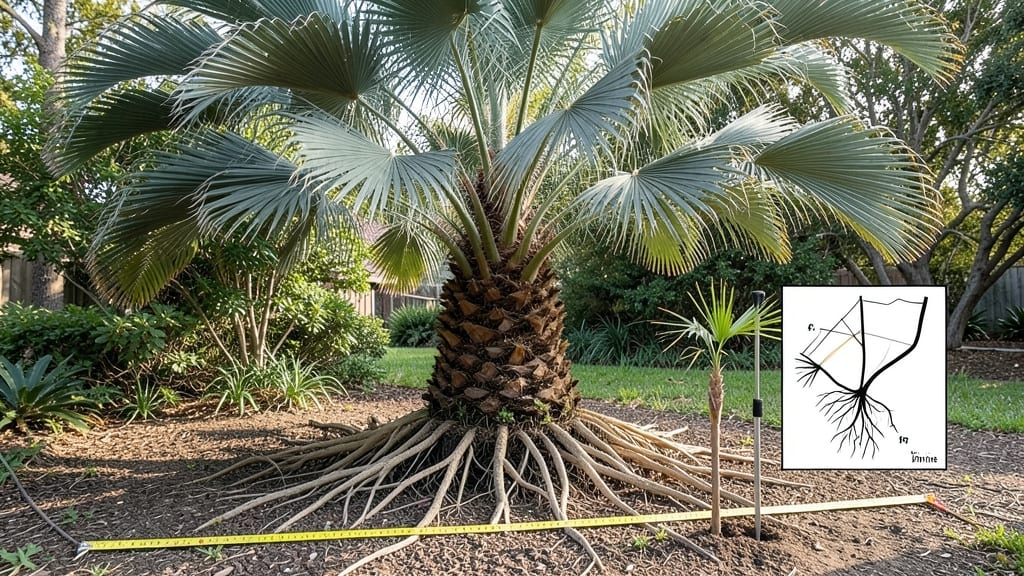
Palm tree roots can stretch 3 to 4 times wider than the tree’s canopy and grow 3 to 6 feet deep, with some varieties like coconut palms extending 15 feet deep and 20 feet wide. The root system combines shallow fibers for stability with deeper anchors to resist wind.
Understanding how far palm tree roots spread is key to planting them safely in your yard. 🌴 The lateral reach means you should space palms at least 15 to 20 feet apart to prevent root competition, especially for larger species.
Smaller palms like pygmy date palms may only need 8 to 10 feet of clearance, but their roots still grow aggressively in search of moisture. In coastal areas, salt-tolerant palms like the sabal palm develop deeper root systems to access fresh water beneath salty topsoil.
Root depth also varies by environment—palms in arid regions often grow deeper to access groundwater, while those in tropical climates may spread wider near the surface. This explains why some palms lean or develop yellow fronds when their roots hit obstacles like sidewalks or underground pipes.
Proper soil aeration during planting can encourage healthier root growth and reduce stress on the tree.
💡 In This Article
- Palm Tree Root Systems by Species: Depth and Spread Variances
- Proper Palm Tree Planting: Avoiding Root Damage and Competition
Palm tree root systems by species: depth and spread variances
The root structure of palm trees varies dramatically between species, with some developing extensive lateral networks while others prioritize deep penetration.
For example, the coconut palm (Cocos nucifera) can send roots down 15 feet or more to access groundwater in coastal environments, while its lateral roots spread 20 feet wide to stabilize against ocean winds.
This deep-reaching system allows coconut palms to thrive in sandy soils where nutrients are scarce below the surface.
In contrast, date palms (Phoenix dactylifera) typically develop shallower but wider root systems, spreading 3 to 5 times their canopy width while only reaching 4 to 6 feet deep.
Their fibrous roots create a dense mat near the surface, perfect for desert conditions where they can quickly absorb seasonal rainfall.
Smaller species like the pygmy date palm (Phoenix roebelenii) follow similar proportions but on a miniature scale, with roots spreading 8 to 10 feet wide and reaching 2 to 3 feet deep.
Climate plays a crucial role in these variations. Palms in tropical rainforests often develop wider, shallower roots to access abundant surface moisture, while those in arid regions grow deeper to tap into groundwater.
The sabal palm (Sabal palmetto), native to the southeastern U.S., exemplifies this adaptation—its roots spread 15 to 20 feet wide while extending 6 to 10 feet deep to avoid competition with saltwater intrusion in coastal areas.
Root spread also determines planting distances. Large palms like the king palm (Archontophoenix cunninghamiana) need 20 to 30 feet between specimens to prevent root competition, while dwarf varieties like the parlor palm (Chamaedorea elegans) can thrive 5 to 8 feet apart.
The key is matching the species' natural root habit to your landscape's available space.
What most people overlook is how root systems evolve with age. Young palms have compact root balls, but as they mature, lateral roots can extend 10 to 20 feet beyond the drip line—the edge of the tree's canopy.
This explains why mature palms often develop leaning trunks when their roots encounter underground obstacles like pipes or sidewalks.
Understanding these species-specific traits helps explain why some palms thrive in urban settings while others struggle. For instance, the Mexican fan palm (Washingtonia robusta) spreads roots 15 feet wide but only 4 feet deep, making it vulnerable to root rot in poorly draining soils.
In contrast, the windmill palm (Trachycarpus fortunei) grows 3 to 5 feet deep with a 10-foot spread, making it more adaptable to temperate climates.