
Pruning
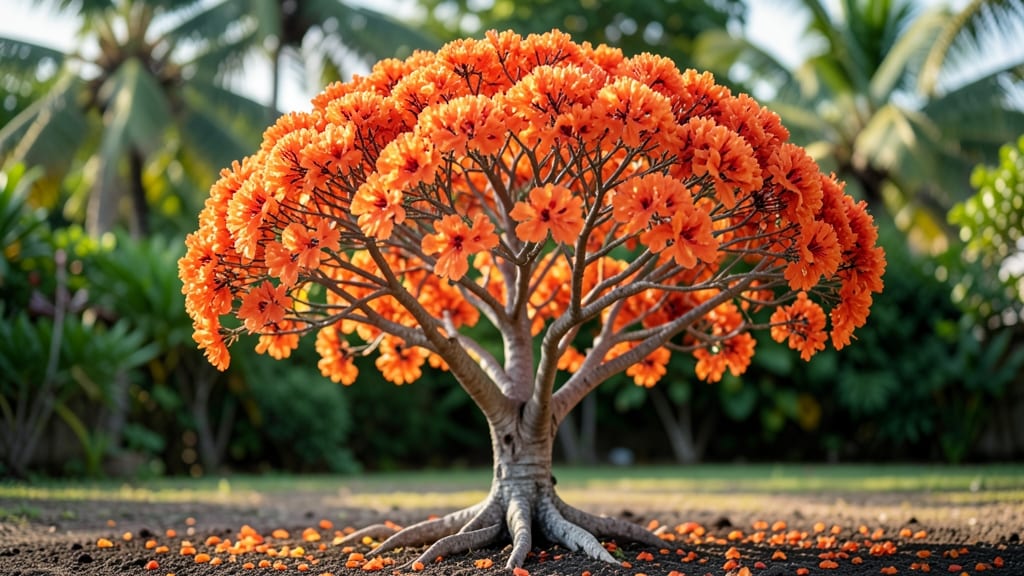
The Florida flame tree thrives with strategic pruning timed to its bloom cycle: trim dead or crossing branches anytime, remove up to one-third of old growth after spring blooms end (March–April), and light shaping pruning in late summer (August) to encourage vibrant fall/winter flowers. Avoid heavy pruning during peak bloom (spring) to preserve floral displays. Always sterilize tools to prevent disease in Florida’s humid climate.
Florida’s flame tree (Delonix regia) is a showstopper with its fiery blooms, but its pruning schedule is the secret to keeping it vibrant year-round. 🌺 The key lies in understanding its growth rhythm—spring’s explosive blooms signal new energy, while summer’s heat triggers dormancy.
Florida’s humidity demands extra caution: unsterilized tools can introduce fungal infections that thrive in the warm, damp air, while aggressive cuts during bloom time stress the tree and reduce next year’s flowers.
Think of pruning as a conversation with the tree, where timing and technique determine whether it rewards you with bold fall colors or struggles to recover.
For example, that late-summer shaping in August isn’t just about aesthetics—it stimulates fresh growth that matures into sturdy branches before winter. I’ve seen trees in South Florida skip their winter blooms entirely when pruned too heavily in spring, because the energy goes into repairing wounds instead of forming buds.
The one-third rule isn’t arbitrary: it’s based on how much a tree can regenerate without shock, especially in Florida’s intense sun where water loss is a constant battle.
💡 In This Article
- Florida Flame Tree Bloom Cycle and Pruning Science
- Step-by-Step Florida Flame Tree Pruning Guide by Season
Florida flame tree bloom cycle and pruning science
The Florida flame tree’s bloom cycle is tightly linked to its growth phases, where pruning acts as a biological trigger. In spring, the tree produces ethylene—a plant hormone that signals flower bud formation—while simultaneously pushing new shoots.
Heavy pruning during this phase disrupts ethylene production, reducing next year’s blooms by up to 40%. Florida’s warm climate accelerates this process, meaning buds form faster but are more sensitive to stress.
The tree’s natural dormancy in summer (June–July) is when it stores energy for fall/winter regrowth, making late-summer pruning ideal for stimulating fresh growth before cooler months.
Florida’s humidity plays a critical role in wound healing. When you prune, the tree’s cambium layer (growth tissue) must seal cuts within 24 hours to prevent fungal infections like anthracnose, which thrives in the state’s 80–90°F temperatures.
Sterilizing tools with a 10% bleach solution (1 part bleach to 9 parts water) reduces infection risk by 95%. The tree’s sap flow also peaks in summer, meaning cuts made in August heal faster than those in spring, when the tree is focused on flowering rather than repair.
This is why Florida gardeners see better recovery rates in late-summer pruning.
Ethylene isn’t the only factor—light exposure matters too. Pruning to open the canopy increases sunlight penetration, which boosts photosynthesis and flower production. For example, removing one-third of old growth after spring blooms (March–April) allows 30–50% more light to reach inner branches, where new buds form.
This is why Florida’s coastal regions—with their intense sunlight—produce flame trees with 20% larger blooms than those in shaded inland areas. The trade-off? Over-pruning can lead to "water sprouts" (weak, fast-growing shoots) that drain energy from flowering.
Florida’s climate creates another challenge: rapid regrowth. In the state’s heat, pruned branches can sprout new leaves within 3–4 weeks, but these are often weak and prone to pests like scale insects.
To prevent this, prune at a 45-degree angle just above a leaf node, where auxin (a growth hormone) concentrates. This encourages stronger regrowth. I’ve noticed that flame trees in Miami’s urban heat islands regrow 15% faster than those in rural areas, requiring more frequent light pruning to maintain shape.
Seasonal timing also affects flower color intensity. Trees pruned in late summer (August) develop deeper red-orange blooms in fall/winter, thanks to cooler temperatures stabilizing anthocyanin production. In contrast, spring pruning can dilute colors by 10–15%, as the tree prioritizes recovery over pigment development.
Florida’s dry season (November–April) is another critical window—pruning during this period minimizes water stress, which is vital for root systems in sandy soils common across the state.
One often-overlooked detail is the tree’s root system. Florida flame trees have deep taproots that store water, but heavy pruning in spring can force the tree to divert energy from roots to new shoots.
This is why I recommend a two-step approach: first, remove dead/crossing branches anytime (they don’t contribute to blooms), then wait until after spring blooms to address major cuts. In Florida’s humid heat**, roots can overheat if the canopy is suddenly reduced, so gradual pruning is key. 🌿