
Trees
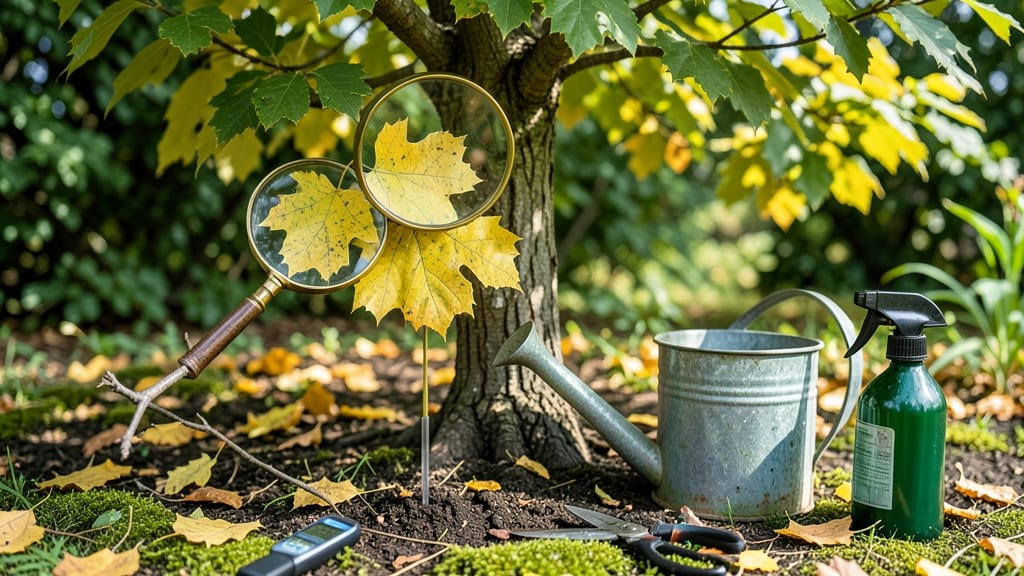
When your elm tree develops yellow leaves, it usually indicates stress from fungal infections like Dutch elm disease, overwatering, nutrient deficiencies, or seasonal changes. Look for specific patterns—like yellowing edges, scattered spots, or drooping branches—to determine the exact issue and choose the right treatment, whether it's pruning, soil amendments, or targeted fungicides.
Yellowing elm leaves don't always mean the tree is dying—often, they're a cry for help that reveals exactly what's wrong. 🌿 For instance, fungal diseases like Dutch elm disease cause yellowing that spreads from the edges inward, while nutrient deficiencies (like iron chlorosis) create yellow patches between leaf veins.
Overwatering leads to a uniform yellowing paired with wilting, whereas seasonal changes produce gradual yellowing as leaves prepare to fall. The key is acting fast: prune infected branches immediately, test your soil for deficiencies, and adjust your watering schedule to prevent further stress.
What's interesting is how elm trees react differently based on their age and species. Younger trees often show stress more dramatically, while mature elms might hide symptoms until the problem is severe.
I always recommend checking the undersides of leaves for signs of pests or fungal growth—sometimes the solution is as simple as improving air circulation around the tree or applying a balanced fertilizer. The sooner you identify the pattern, the easier it is to revive your elm's health.
💡 In This Article
- Diagnosing Elm Tree Leaf Discoloration Patterns
- Step-by-Step Elm Tree Care Fixes for Yellowing Leaves
Diagnosing elm tree leaf discoloration patterns
Elm trees express stress through distinct leaf color patterns that act like a diagnostic map. For example, Dutch elm disease—caused by the fungus Ophiostoma novo-ulmi—starts with yellowing between leaf veins, then progresses to brown, curled edges as the vascular system clogs.
This disease spreads through bark beetles, so you might also spot small exit holes or sawdust-like frass at branch junctions. Powdery mildew, another common fungal issue, creates a white, powdery coating on upper leaf surfaces while yellowing appears on undersides, often in humid conditions.
The key to accurate diagnosis lies in examining leaf edges and vein patterns. Iron chlorosis—common in alkaline soils—produces bright yellow leaves with green veins, while nitrogen deficiency causes uniform yellowing that starts at the oldest leaves and moves upward.
Overwatering triggers a dull yellow hue paired with wilting, as roots suffocate in soggy soil, whereas drought stress creates crispy, brown-edged leaves that curl inward. Seasonal yellowing, however, follows a predictable timeline: leaves turn yellow from the tips downward in autumn, often accompanied by a slight orange tint before falling.
Timing matters too. Early spring yellowing often signals fungal diseases or pest damage, while summer yellowing typically points to environmental stressors like improper watering or heatwave damage. I’ve noticed that elms in urban areas with compacted soil show more deficiency symptoms, while those in wet climates frequently battle fungal infections.
The best time to inspect is on a cloudy morning when leaves are fully hydrated—this reveals subtle discolorations that might vanish under midday sun.
Don’t overlook the bark and branch structure. Dutch elm disease, for instance, causes branch dieback where the fungus blocks water flow, leading to sudden wilting even in healthy-looking foliage. Young elms often display symptoms more dramatically, while mature trees might only show crown thinning until the disease is advanced.
Consider using a magnifying glass to check for tiny fungal spores or spider mite webbing, which can mimic nutrient deficiencies if overlooked.
For precise identification, compare your findings against these common patterns:
- Dutch elm disease: Yellowing between veins, brown edges, branch dieback, beetle holes
- Iron chlorosis: Yellow leaves with green veins, often in alkaline soil
- Overwatering: Uniform yellow, wilting, possible root rot smell
- Seasonal change: Gradual yellowing from tips, orange undertones, natural leaf drop
What most people miss is how leaf texture changes with each condition. Fungal-infected leaves feel brittle and papery, while nutrient-deficient leaves stay soft but thin. By combining visual patterns with seasonal timing, you can narrow down the cause within minutes—saving your elm from irreversible damage. 🌿